
The commitment-to-action gap
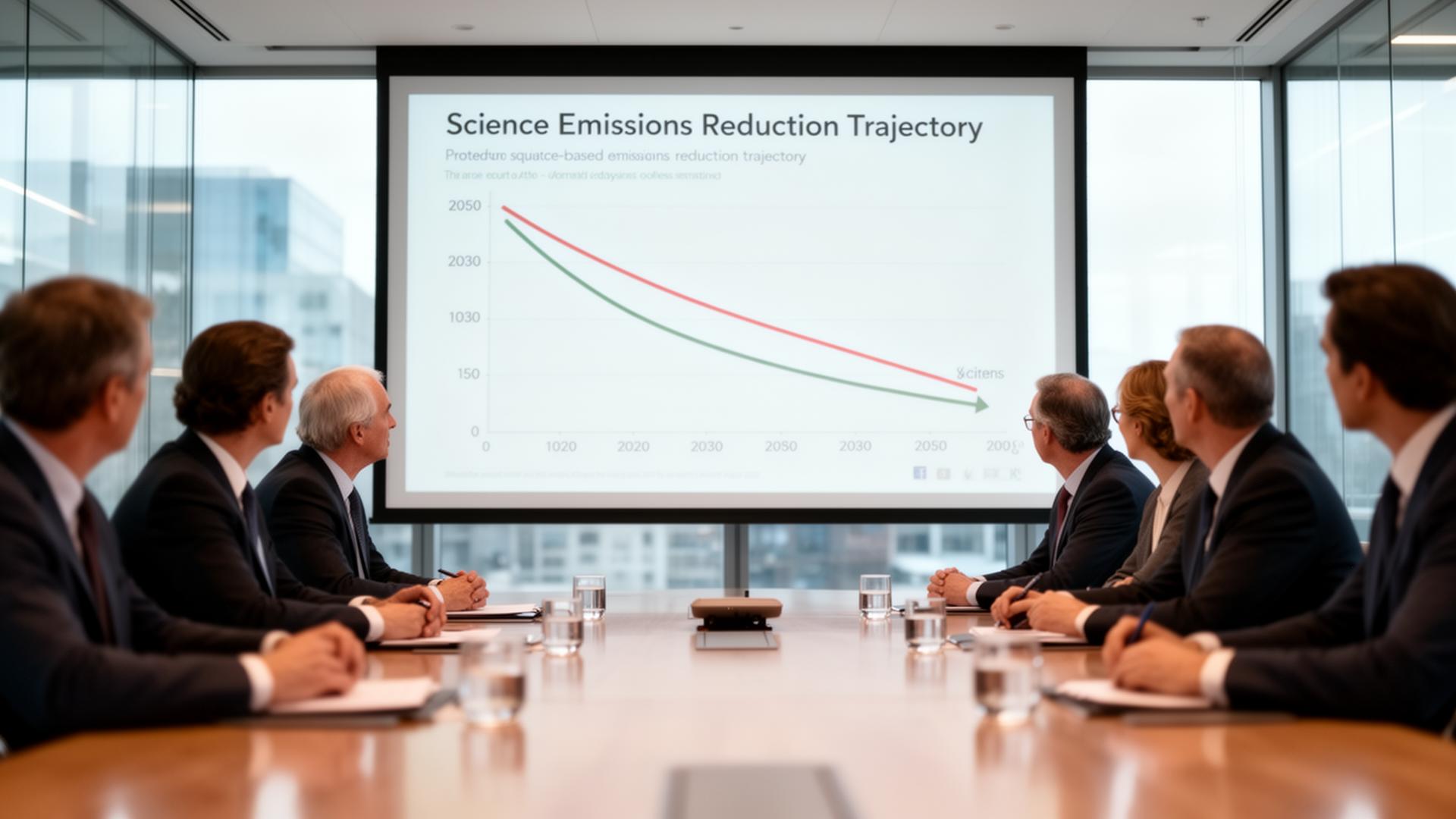
Over 7,000 companies have committed to SBTi. Far fewer can show a credible, costed pathway. The gap is rarely intent — it is the absence of a system that connects a 2030 absolute reduction target to next quarter's capital plan.
Without that system, a target becomes a press release. Each functional team continues to optimise for its own KPIs, capital is allocated using the same hurdle rates as a decade ago, and the gap to trajectory grows quietly until a board paper finally surfaces it three years too late. The fix is not more ambition; it is operational translation.
Decompose the trajectory
A 42% absolute reduction by 2030 must be decomposed by scope, by business unit, by site, and by lever — energy efficiency, electrification, fuel switching, renewable PPAs, supplier engagement, product redesign. Each lever then gets an owner, a budget envelope, and a milestone schedule. Decomposition turns a single intimidating number into a portfolio of tractable initiatives.
gCurv's Carbon Management module models this decomposition as a living tree. Move a single assumption — say, the year a coal boiler is retired — and the trajectory recalculates downstream, surfacing the new gap to be closed elsewhere. Leadership sees the cascade in real time rather than waiting six weeks for the consultancy to refresh the model.
Decomposition also exposes the unspoken assumptions in a target. Many companies discover that their 'plan' implicitly relies on grid decarbonisation doing 60% of the work. Once that is visible, the conversation about owned action versus inherited progress becomes honest, and the residual gap can be planned for properly.

Marginal abatement, properly costed
MAC curves built once and printed in a deck age badly. Energy prices, factor updates, and project completions shift the economics constantly. The platform keeps the curve live, so investment committees see today's cost of carbon avoided, not last year's.
A live MAC curve also forces honesty about which projects are truly economic at internal carbon prices and which depend on external incentives, regulatory pressure, or strategic premium. That clarity is what unlocks executive sponsorship; vague green capex requests do not survive a competitive capital allocation process, but transparent ones do.
Governance that holds
Every initiative is reviewed quarterly with the same rigour as a financial KPI: planned vs actual abatement, capex deployed, payback realised, risks logged. When a target slips, the platform shows exactly which initiative drifted and why — turning sustainability governance into a normal operating discipline.
Quarterly governance also creates the muscle memory that sustains delivery across leadership changes. A new CFO inheriting the programme should be able to read the last four quarterly reviews and understand exactly where the gap is, what is being done, and which decisions are pending. That continuity is what separates programmes that survive a CEO transition from those that quietly evaporate.
Linking transition plans to capital allocation
A credible transition plan, in the language of TCFD and ISSB S2, is not a narrative document — it is a multi-year capital schedule with named projects, expected abatement, and contingencies. Investors are increasingly scoring these plans on the same dimensions used to score acquisitions: scenario robustness, execution track record, and alignment with stated strategy.
Embedding the transition plan inside the company's normal capital planning cycle is the single highest-leverage governance move available. It removes the parallel-process fatigue that kills sustainability programmes and ensures every gate review (concept, FEL-1, FEL-2, sanction) carries an explicit carbon line alongside cost and schedule.
When transition planning and capital allocation merge, sustainability stops being a separate ledger to defend. It becomes one of three or four lenses every major investment is evaluated through, alongside financial return, strategic fit, and risk.
Workforce and capability
Targets are delivered by people, not platforms. A 2030 trajectory implies hiring profiles, training curricula, and succession plans that most organisations have not yet built. Process engineers fluent in heat pumps, procurement specialists trained in PPA structuring, and product designers who can read an LCA — these are not adjacencies, they are core capabilities for the next decade.
The most resilient programmes invest in capability building with the same seriousness they invest in capex. A graduate rotation through carbon strategy, a dedicated decarbonisation engineering function inside operations, and a structured upskilling pathway for the existing workforce all compound over time. The platform supports this by making expertise visible: who has touched which initiatives, who has approved which methodologies, who is the de facto expert when a question arrives.
From playbook to muscle
The end state is unglamorous. There is no single moment when an SBTi commitment becomes operational; there is only a steady accumulation of quarterly reviews, sanctioned projects, supplier conversations, and small design decisions, each one logged, scored, and connected to the trajectory.
Companies that arrive at 2030 within range of their target will, almost without exception, have built this muscle five or six years earlier. The platform exists to compress the learning curve, expose the gaps early, and make the right behaviours easier than the wrong ones. The playbook is real work — but it is repeatable work, and that is what makes it deliverable.
Designing for trajectory, not tactics
Quarterly delivery sounds tactical, but the cumulative pattern of quarterly choices defines the trajectory. A programme that hits every quarterly milestone for two years and then stalls — because the easy wins are exhausted and the hard projects were deferred — is not on track. A programme that misses early milestones because it is investing in long-lead-time capabilities (electrification engineering, PPA contracting, supplier engagement infrastructure) may look behind but is actually further ahead.
Distinguishing tactical progress from trajectory progress is one of the most important governance disciplines a sustainability function can develop. The platform makes both visible: short-term abatement delivered, and long-term capabilities under construction. Boards that learn to read both signals avoid the trap of optimising the dashboard at the expense of the destination.
This framing also rebalances the conversation about easy wins. LED retrofits and HVAC upgrades are real abatement, but they cannot substitute for the harder, slower work of process electrification or fuel switching. Including both in the trajectory model — with realistic costs and lead times — keeps the executive team honest about what 2030 actually requires.
Scenario planning under uncertainty
Energy prices, regulatory pressure, technology cost curves, and grid decarbonisation all evolve unpredictably. A trajectory that depends on a single set of assumptions will be wrong; the question is by how much and in which direction.
Scenario planning addresses this head-on. The platform supports running the same trajectory under multiple coherent assumption sets — a high-electricity-price scenario, a slow-grid-decarbonisation scenario, a fast-policy-tightening scenario — and exposes which initiatives are robust across scenarios and which depend on a specific outcome.
This is the kind of analysis ISSB S2 and CSRD ESRS E1 increasingly expect. Disclosing scenarios used, key sensitivities, and the resilience of the transition plan is now standard for serious programmes. Doing the analysis once a year for disclosure is fine; doing it continuously to inform decisions is what separates companies from competitors.
Beyond Scope 3.15: financed and facilitated emissions
For financial institutions and large corporates with significant treasury or investment activity, financed and facilitated emissions add a layer of complexity that traditional Scope 3 frameworks struggled to capture cleanly. PCAF methodology has matured rapidly, and SBTi's financial sector pathways now expect explicit disclosure and target-setting on these categories.
Even non-financial corporates face increasing scrutiny on the climate impact of their treasury reserves, pension plan investments, and venture capital arms. Bringing these activities inside the trajectory — rather than excluding them as out-of-scope — produces a more complete picture and avoids the awkward situation of a strong operational programme being undermined by a misaligned investment portfolio.
The platform integrates PCAF-aligned financed emissions calculations alongside operational emissions, so a single trajectory and a single set of governance disciplines apply across the full footprint. That coherence is what investors increasingly look for when evaluating transition plans.
Communicating progress to stakeholders
A target only delivers full value if stakeholders trust the trajectory toward it. Investors, customers, regulators, employees, and communities all increasingly evaluate companies on the credibility of their transition plan, not just the ambition of the headline number.
Credible communication shows the trajectory, the initiatives behind it, the assumptions, and the gaps. It avoids the two failure modes that erode trust: triumphalism that ignores remaining gaps, and excessive hedging that signals lack of conviction. The best communicators are precise about what is delivered, transparent about what is at risk, and clear about what they are doing about it.
The platform produces audience-tailored progress views — investor briefings, customer scorecards, regulator filings, employee dashboards — from the same underlying data, so that consistency is automatic and the team's energy goes to interpretation rather than re-keying. Trust is built through repeated, consistent, evidenced communication; the architecture is what makes that sustainable.
Over time, this discipline produces a stakeholder base that understands the journey and supports it through inevitable bumps. That patient capital and patient customer relationships are themselves an asset that competitors without the same communication rigour cannot easily match.
Deeper dives on adjacent topics
We curate independent perspectives that complement this article. The links below point to detailed analyses on packgine.ai — a sister source for packaging compliance, EPR, PPWR, and circularity.